
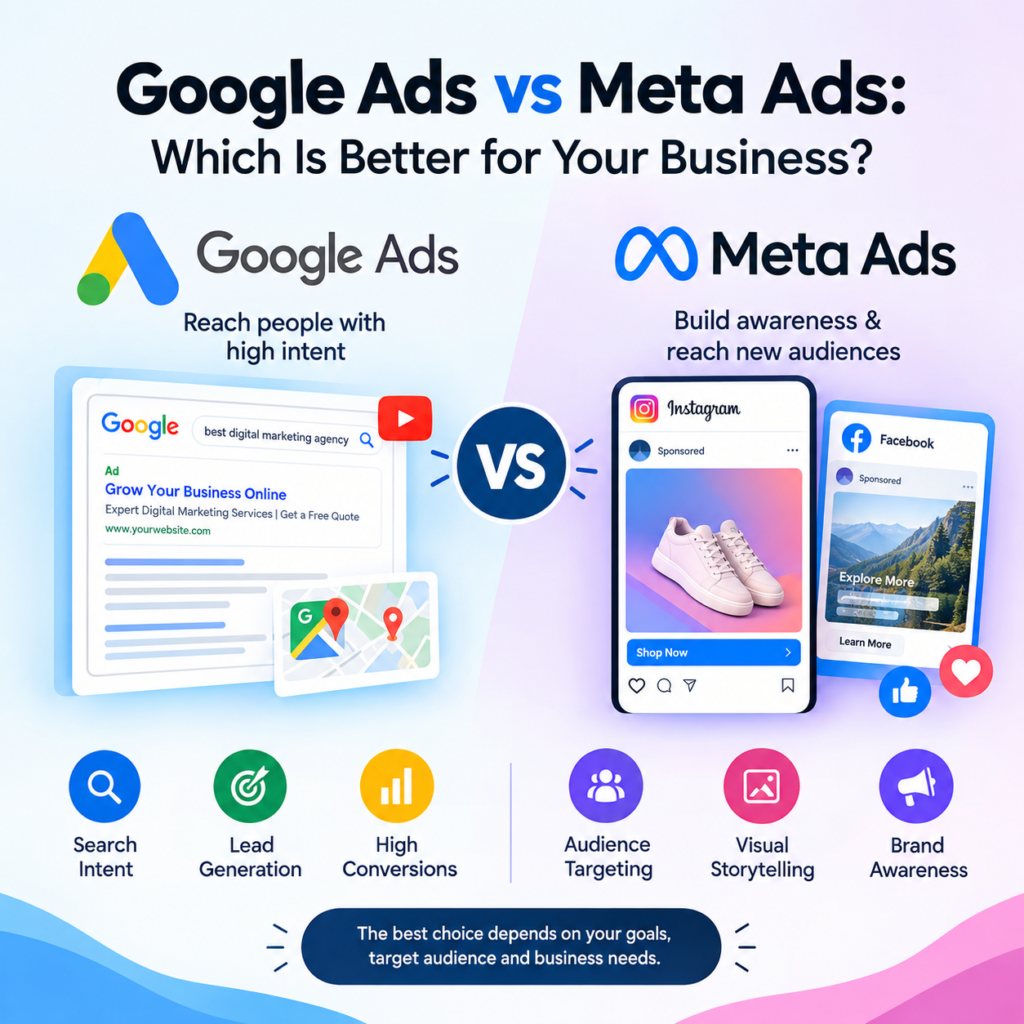
Choosing the right advertising platform can make a significant difference to your business growth. Two of the most popular options are Google Ads and Meta Ads (Facebook and Instagram). Both platforms can generate leads, sales, website traffic, and brand awareness—but they work in very different ways.
So, which one is better for your business? The answer depends on your goals, target audience, budget, and customer journey.
What Are Google Ads?
Google Ads is a paid advertising platform that allows businesses to appear across Google Search, YouTube, Google Maps, and Google’s wider advertising network.
One of its biggest advantages is search intent. When someone searches for terms such as “best digital marketing agency near me” or “buy running shoes online,” they are already looking for a solution.
Google Ads allows businesses to reach these potential customers at the moment they are actively searching.
Benefits of Google Ads
- Reaches people with high purchase intent
- Excellent for lead generation and direct sales
- Targeting based on keywords and search intent
- Measurable results and conversion tracking
- Suitable for local and service-based businesses
- Can generate immediate visibility on Google
For example, a plumbing company can target searches such as “emergency plumber near me.” Someone making that search is likely to need the service immediately, making Google Ads highly valuable.
What Are Meta Ads?
Meta Ads allow businesses to advertise across platforms such as Facebook and Instagram. Unlike Google Search Ads, Meta Ads generally don’t wait for users to search for a product or service.
Instead, businesses can target people based on demographics, interests, behaviors, location, and other audience signals.
Meta is particularly powerful for visual marketing, brand discovery, engagement, and product promotion.
Benefits of Meta Ads
- Powerful audience targeting
- Excellent for visual and video content
- Strong platform for brand awareness
- Effective for e-commerce and consumer brands
- Useful for retargeting website visitors
- Often provides cost-effective reach
For example, a fashion brand can show Instagram ads featuring a new collection to people interested in fashion, online shopping, or similar brands.
Google Ads vs Meta Ads: Key Differences
| Feature | Google Ads | Meta Ads |
|---|---|---|
| Primary approach | Search & intent-based | Interest & audience-based |
| Best for | Leads and direct conversions | Awareness, discovery & sales |
| Audience intent | Usually high | Usually lower initially |
| Visual content | Moderate | Very strong |
| Targeting | Keywords, location, audience signals | Demographics, interests, behaviors |
| Platforms | Google, YouTube, Maps, partner networks | Facebook, Instagram |
| Best customer stage | Consideration & decision | Awareness & consideration |
Which Platform Has Better ROI?
There is no universal answer.
Your return on investment depends on factors such as your industry, competition, offer, landing page, ad creative, targeting, and conversion rate.
Google Ads can deliver strong ROI when customers are actively searching for your products or services. However, competitive keywords can become expensive.
Meta Ads can provide affordable reach and powerful targeting, but converting users may require stronger creative, offers, and retargeting strategies because they may not be actively looking to buy.
The best approach is to measure cost per lead, cost per acquisition, conversion rate, revenue, and return on ad spend (ROAS) rather than focusing only on clicks or impressions.
When Should You Choose Google Ads?
Google Ads may be the better choice if:
- Customers actively search for your services
- You want immediate lead generation
- You operate a local business
- Your product or service solves an existing problem
- You want to capture high-intent traffic
- You have a strong landing page and conversion process
For example, businesses such as lawyers, dentists, home-service companies, education providers, and B2B service companies can benefit significantly from search advertising.
When Should You Choose Meta Ads?
Meta Ads may be a better option if:
- Your product is highly visual
- You want to build brand awareness
- You sell fashion, beauty, food, lifestyle, or consumer products
- You have engaging videos or images
- You want to reach specific audience segments
- You want to retarget potential customers
Instagram and Facebook can be particularly effective for businesses that can demonstrate their products visually.
Why Use Google Ads and Meta Ads Together?
For many businesses, the best strategy isn’t choosing one platform—it is using both strategically.
Google Ads can capture customers who are already searching for a solution, while Meta Ads can introduce your brand to potential customers and keep your business visible through retargeting.
For example:
Meta Ads → Brand discovery → Website visit → Retargeting → Google Search → Conversion
This creates a more complete customer journey instead of relying on a single advertising channel.
Final Thoughts
So, Google Ads vs Meta Ads—which is better?
Google Ads is generally stronger for high-intent searches, lead generation, and customers who are ready to take action. Meta Ads is often stronger for brand awareness, audience discovery, visual storytelling, and e-commerce marketing.
The right choice depends on your business objectives and target audience.
For many businesses, a combination of Google Ads + Meta Ads + conversion-focused landing pages + continuous optimization can deliver better long-term results than relying on a single channel.
The key isn’t simply spending more on advertising. It’s reaching the right audience, with the right message, at the right stage of the customer journey.